
One-off, periodic or continuous. Three cadences, one engine.
The formal campaign remains the instrument of periodic controls and regulatory obligations. Continuous assurance takes over between two campaigns. Both share the same policies, the same owners and the same evidence.
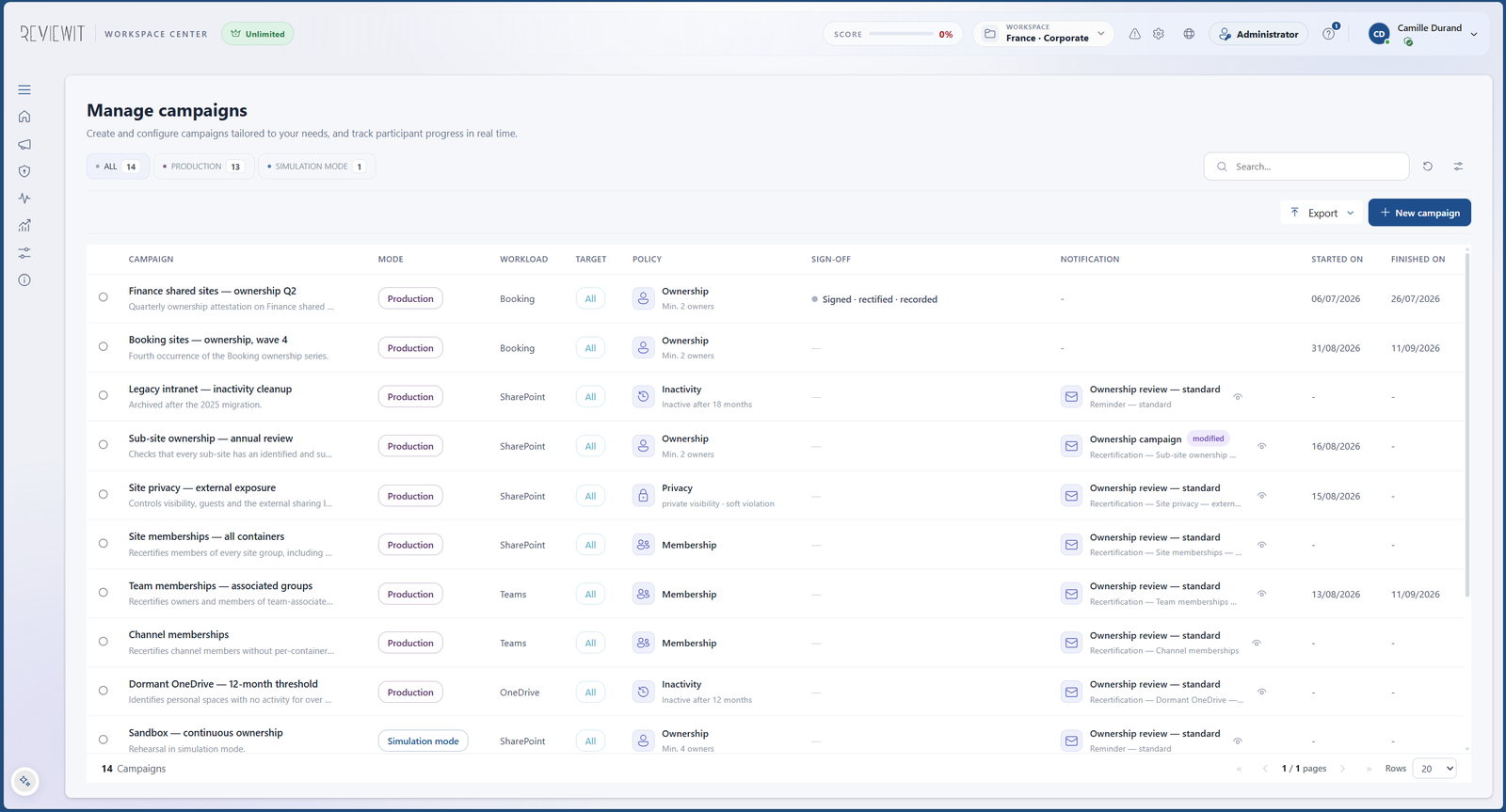
Choose what to certify, then how.
A campaign applies one or more policies to a scope, then organises the decision.
Scope and policies
Which resources, which access, and which questions to ask them from the policy catalogue.
Owners
Who must answer: owners, managers, dedicated team.
Decisions
Each owner decides, delegates or asks for an opinion.
Attestation
Closure is signed by a named person, then sealed with the decisions and the scope: verifiable offline.
Remediation
What must change is tracked until verified.
Evidence
Every refusal opens a correction, tracked until a later collection confirms it.
What is being certified, against which business criterion?
The question asked and the decision expected. They are described in the policy catalogue.
How is the certification executed?
Reviewers, quorum, cadence, inheritance, reminders: the settings detailed further down this page.
Up to three launch dates
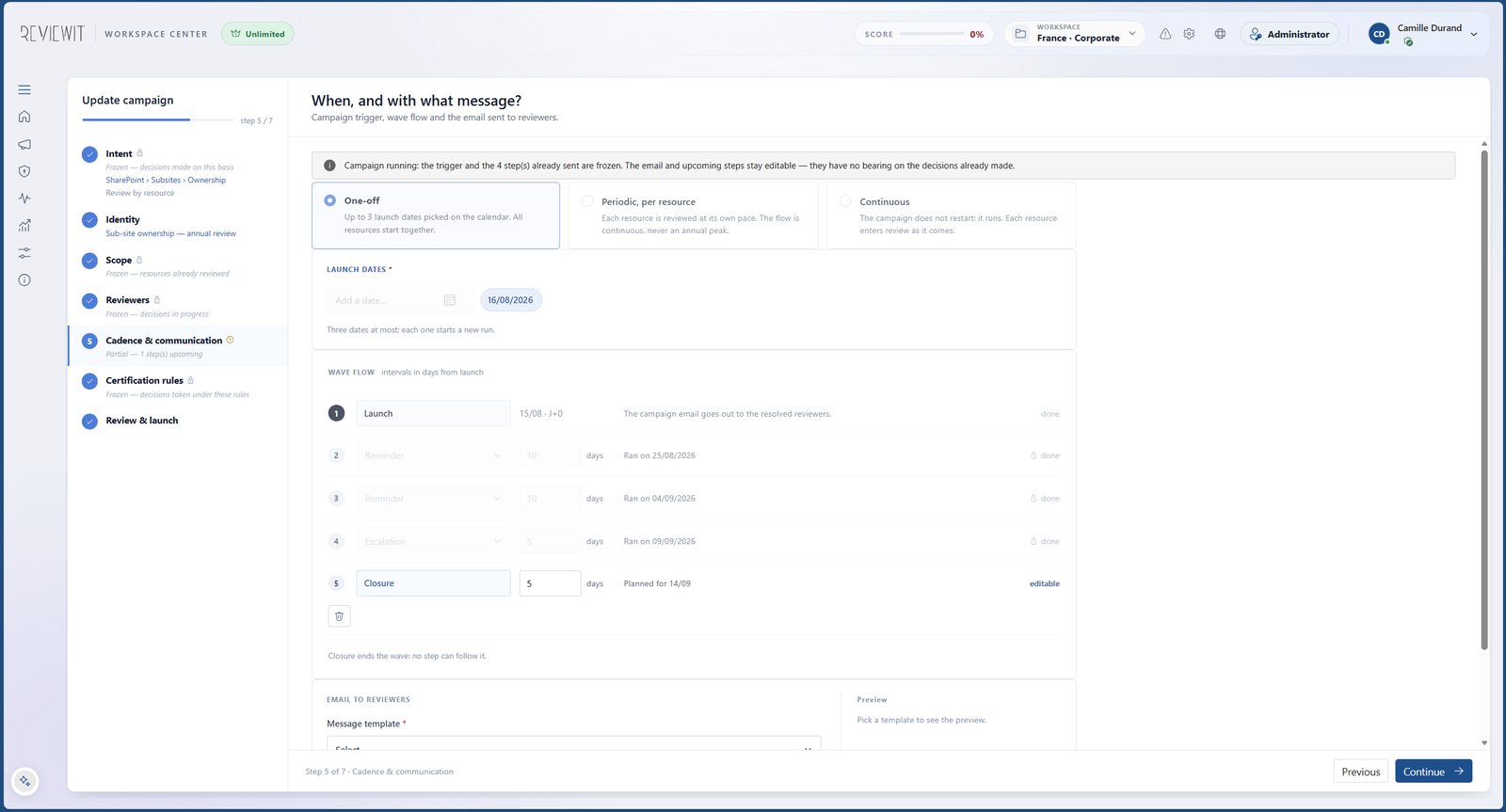
All resources start together. For an audit, bringing an estate under governance, a compliance deadline. Available in OneShot and Unlimited.
Each resource at its own pace
Each unit is reviewed at its own cadence. The flow is continuous, with no annual peak. In OneShot, one debit per occurrence.
The campaign does not restart: it keeps running
Each unit enters review when a change or a term requires it. Obligations are grouped into cohorts. Unlimited edition.
Seven steps. What is frozen is frozen for a reason.
From the first decision, the intent, scope, reviewers and rules no longer change: the decisions already made were made on that basis. Only the message and the steps still to come can be edited.
Nothing is closed until the decision is sealed.
Named sign-off
Closure is a human act, signed by an identified person. The platform never signs on anyone’s behalf.
Sealed attestation
Decisions, reviewers, timestamps and frozen scope, chained into an evidence segment verifiable offline.
Terms set
Each decision receives its maximum term. Continuous assurance inherits it and monitors its validity.
Comparable series
Two occurrences of the same configuration form a series. INSIGHTS says what changed between the two.
Certification policies, extensible by design.
Each policy is a campaign extension with its own settings: minimum owners, acceptance required, appointment strategy for orphans, inactivity thresholds. Add your own when your control framework requires it.
A scope you can state, and gaps that are named.
The scope is either calculated from the estate collected at each occurrence, or imported as a selection. Conditions are normalised into a signature, so that two campaigns filtering the same thing are recognised as comparable.
Conditions.
Up to three attribute filters, operators equals, not equal to, starts with, ends with, contains, does not contain, multi-valued, chained by and / or.
Sanctuary.
Resources placed outside review, in traced cycles with a reason and a term. Exclusions are counted in the wizard, and each becomes a visible finding at freeze.
Gaps at freeze.
Not identifiable, out of scope, in sanctuary, orphaned, unmatched import rows. Recorded once, at arming, as findings in the alert centre.
Frozen, then only shrinking.
After the freeze, objects that disappear from collection are put on hold, never deleted. No new object enters a running occurrence.
Appointed, justified, never invented.
Reviewer resolution is a named phase with a justifiable result: appointed by this mode, failing that by this fallback. An object with no resolvable reviewer produces a finding and no request. The engine never invents an address.
Fourteen rules, three tiers, and a badge that cannot lie.
Rules are resolved one by one, never as a block: the platform default, then the workspace override, then the campaign override. An override equal to the inherited value is never written, so the provenance badge always tells the truth.
Decisions.
Notify users on revocation. Require a comment for approval, for revocation. Enable consultation.
Challenge.
Enable a challenge period and set its default duration.
Waivers.
Allow temporary waivers and set the default duration.
Delegation and bulk actions.
Disable transfer by delegation. Enable bulk approval, bulk revocation, bulk waiver, bulk reassignment.
Sign-off.
Require the reviewer’s sign-off on the batch.
Closure mode.
Expire what is undecided, or attest it with a default verdict per policy criterion.
A nuanced vocabulary, and a single round trip to challenge.
Reviewers decide per criterion when the policy has several, and the strongest reservation wins in the aggregate. Escalation and cancellation are transfers, never decisions, and reporting never confuses the two.
Atomic on the way in, ordered on the way out.
An occurrence is armed in five ordered phases and becomes active only after the fifth. Credits are debited on the frozen snapshot and compensated on failure. Closure runs in five acts, and the challenge window blocks none of them.
Outcomes are named
Armed, skipped because the previous occurrence is still open, rejected, failed with the debit compensated, already armed, busy. Never silence.
Watchdog and re-arming
An occurrence stuck in arming for more than an hour is declared dead before anything new is armed. Re-arming is a human act, offered only when the last occurrence failed.
Closure in five acts
Stop reminders and escalations, expire or attest what is open, close the findings, mark the occurrence closed, publish the certification file. Then seal.
Declared by the engine, delivered by an outbox.
The step engine emits trigger codes. It never sends mail itself. An outbox resolves the recipient’s preferences and language, picks the template by cascade, merges the tokens and hands the message to the provider. Everything it does can be replayed and measured.
Templates.
A local catalogue per workspace and a global platform catalogue, by category, language and status, with preview. A template in use cannot be deleted.
Preferences.
Each person switches assignments, reminders, escalations, digests and challenges on or off. Governance transactional messages, such as a challenge raised or a revocation notice, are always sent.
Languages.
Enabled languages with a fallback, normalised whatever the source.
Delivery.
Four providers resolved by sender domain, consolidated delivery events, manual replay for operators.
Everything a workspace manager needs to run it.
States you can rely on
Not started, paused, active, finished, cancelled, archived. Archiving is reachable only from finished or cancelled. A campaign finishes only after a cycle has really closed.
Grid actions
Start now, pause, resume, cancel with justification, archive, duplicate, recycle, re-arm. Each action propagates to the underlying occurrences.
Campaign detail
Progress by decision family, decisions expected, reviewers, launch and closure schedule with countdown, configuration summary, cost in credits.
Closure panel
Batches attested out of total, package download, sealing badge and per-batch verification, closure rank, coverage, fingerprint and sealing reference.
Health detection
Stalled campaigns, late reviews and silent occurrences feed the alert centre with thresholds set by your subscription.
Webhooks and API
Campaign events, including a dedicated sign-off event, pushed to your systems. Automation through the public API, never a decision.
Certified yesterday. Provable today.
A demonstration in your context: your solutions, your scopes, your agents.