
Evidence your auditor verifies without us.
From observation to human decision, from decision to attestation, from attestation to sealing: every link is traced, chained and verifiable. And what cannot be demonstrated is stated, cause by cause.
What was seen
Each collection is dated, attributed to a connection, and kept. The absence of observation is a fact, recorded as such.
Who decided
A named person, with their authority at the time of the decision, their justification and the rules under which they decided.
What is certified
The object, its observed state, the validity conditions, the maximum term and the evidence references.
SEAL
Events are chained by fingerprint and sealed by segment. Any alteration breaks the chain, and the break shows.
Without REVYCORE
A verification package, the authority’s public key, a published contract. The verdict is recomputed offline.
As of a given date
What was certified, valid and demonstrable on the day requested — read as it was, not as it has become.
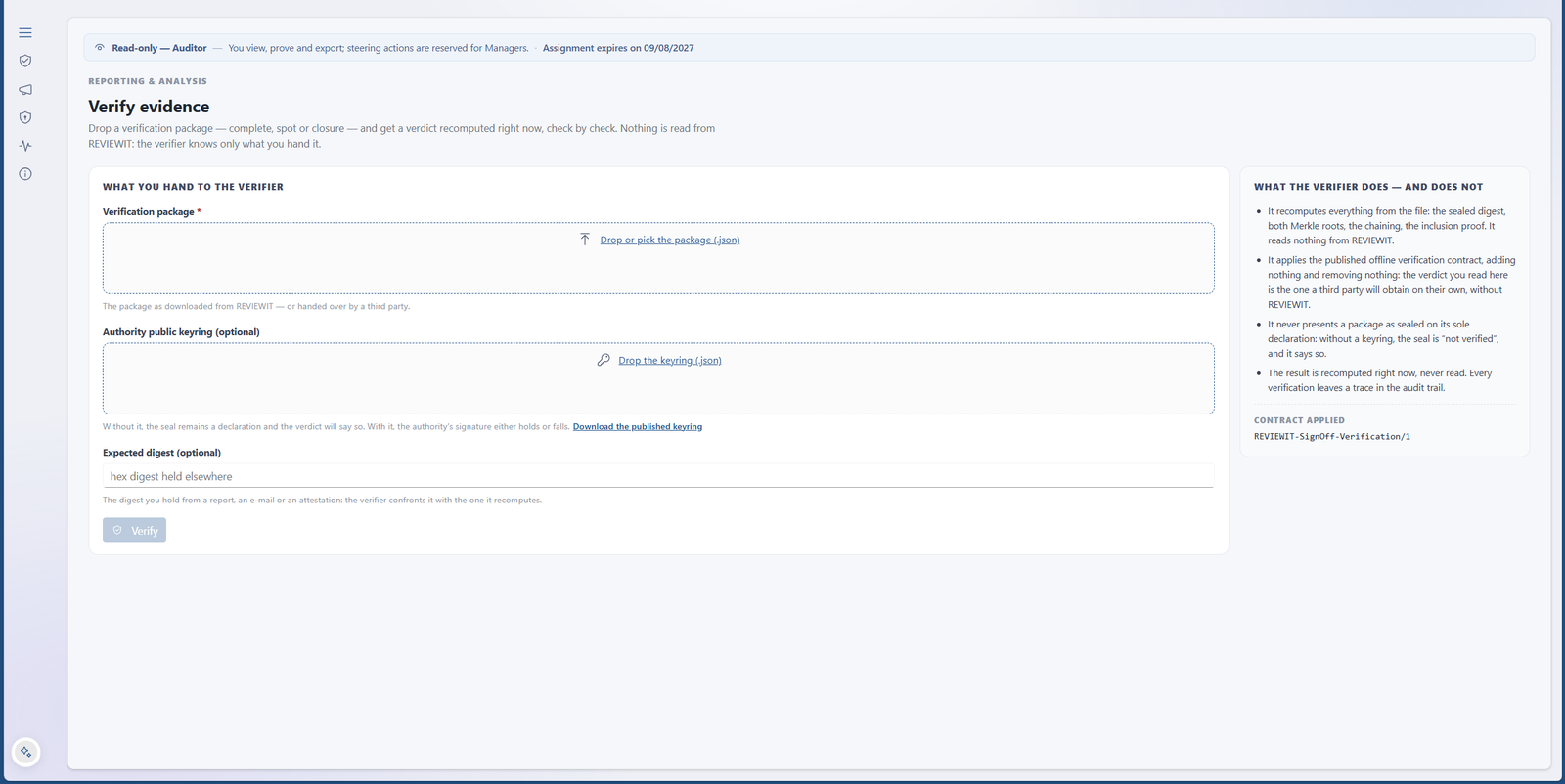
Your auditor does not have to take your word for it. They verify it themselves.
Read-only access, flagged by a permanent banner and bounded by an assignment end date. The auditor consults, proves and exports; they run no campaign and make no decision. Their audit posture answers one question: what can this workspace really demonstrate?
Sovereign by design, in SaaS and on-premises alike.
Data and keys in your jurisdiction
Regional hosting and a sealing authority per region in SaaS; your vault and your authority on-premises.
No standing vendor access
REVYCORE’s operations go through a dedicated, traced console that never takes on a client’s colours.
Least privilege on your solutions
Each connection uses its own identity, read-only. The entitlements requested are documented per connector.
Partitioning by workspace
Delegated scopes, roles and credits. A manager sees only what is entrusted to them.
Governed retention
Evidence segments follow your retention policy. A purged segment shortens the trail, without altering it.
Integration with your SOC
BEACON streams every decision to your SIEM. The public API exposes attestations and obligations.
Deployment modes are detailed on the Editions page →
Built for sovereignty requirements. Starting with Europe.
Ministries, agencies, local authorities, operators of essential services and regulated industries face the same requirement, whatever their jurisdiction: keep the data, the keys and the decision at home, and prove it. REVYCORE was designed for that requirement from the first line of code, not adapted afterwards. It opens in Europe first, and the same architecture serves any region.
A region you choose, and nothing leaves it
Authentication, sealing authority, secrets, mail, audit trail: every service runs in the region of your subscription. The control plane holds only metadata and never reads inside a region. The metering channel cannot even carry your data.
A dedicated silo when you need one
Shared cell for most, dedicated account for large groups: one silo, one client, never two. Migration between them is a move, never a copy. On your own servers when the regulator requires it.
One key per tenant, no platform secret
Each subscription seals with its own key in a vault that application hosts cannot open. One OAuth application per client, so there is no platform-wide secret to steal. You can import your own signing key into it; customer-managed keys for data encryption are on the roadmap.
The vendor does not see your data
REVYCORE staff never have implicit access to client data. Support access is explicit, time-bound, consented to by you and written into your own audit trail. The same rule that stops administrators from deciding stops the vendor from reading.
Evidence that stands without us
The trail is chained and sealed. The verifier is the same in the console and on the command line, and the authority’s keyring is published at a known address, anchored on its root key. An auditor can verify a package with no account and without calling us.
Humans decide, always
No system signature, no delegated signatory, no decision action in the assistant’s contract. Facing the AI Act or a works council, the answer is structural, not a policy. Sovereignty over the decision is the one nobody else offers.
Your jurisdiction, by design
One region per subscription, opened where your law applies, so your data stays under that law and out of reach of extraterritorial disclosure. European regions first, others on request. On-premises deployment for isolated or classified environments.
Evidence for your frameworks
Periodic certification of access, ownership and resource compliance with sealed evidence is what NIS2, DORA, the AI Act and their equivalents elsewhere ask a public body or an operator of essential services to demonstrate. Human oversight of the assistant is structural, not a policy.
Leave with everything, verify without us
Evidence, audit trail and configuration can be exported in open formats, the verifier and its keyring are published, and the on-premises edition runs the same platform. No lock-in on the evidence, no dependence on the vendor to read it.
SEAL seals. BEACON streams.
Your security operations must see what your reviewers did, in the tool they already monitor. BEACON streams the audit trail to your SIEM as it is written, in a single open format, with a per-batch manifest your team can verify without asking us.
Automate everything around the decision. Never the decision.
A REST API for your tooling: read campaigns and their configuration, follow reviews and their effective decision, extract the audit trail by cursor, generate signed evidence on demand, track deletion requests, browse the resource catalogue. Only one thing is impossible by design: posting a review decision.
Defence in depth, governed like everything else.
TrustGate
An identity broker in front of every console. Entra ID, Google and generic OIDC providers. Strengthened MFA on administration surfaces with enforced authentication freshness, and a configuration guide per provider.
Secrets in a vault, never in files
No secret lives in configuration. Client keys, the assistant’s call secret and the platform’s own identities are kept in the vault and rotated by jobs, never by hand.
Signing key and encryption
Import your own signing key: your evidence is sealed with it. Customer-managed keys for data encryption are on the roadmap. Encryption at rest and in transit, tenant isolation by design, and a regional foundation so your data stays in your region.
BEACON
The audit trail streamed to your SIEM in OCSF, one checkpoint per destination, verifiable batches, egress as a security boundary. How BEACON streams →
Public API
Read campaigns, reviews, evidence, audit, deletions and resources with narrowly scoped machine clients. No script can decide. What the API exposes →
Operational health
Every background job publishes a summary. A job that stays silent is a finding, not a comfort. Alerts on jobs and services are visible to your subscription.
Retention you can sign off, deletion you can follow.
Retention module
Each data category is declared with a retention period and a purge behaviour, consistent with the DPA clause in your contract. What is purged is purged by segment, never by row.
Legal holds
A hold suspends purging for a subscription, a campaign or a category, with a reason and an owner. Evidence under hold outlives its retention until the hold is lifted.
Deletion requests
A reviewer can request the deletion of a resource. The request is tracked from filing to execution or refusal, with the trace of who handled it and why.
Aligned with what your auditors expect.
Certified yesterday. Provable today.
A demonstration in your context: your solutions, your scopes, your agents.