
Reports prove the review took place. INSIGHTS says whether it worked.
The second campaign on the same scope should not cost just as much and still teach nothing. INSIGHTS builds series from comparable occurrences, then compares two closures, object by object.
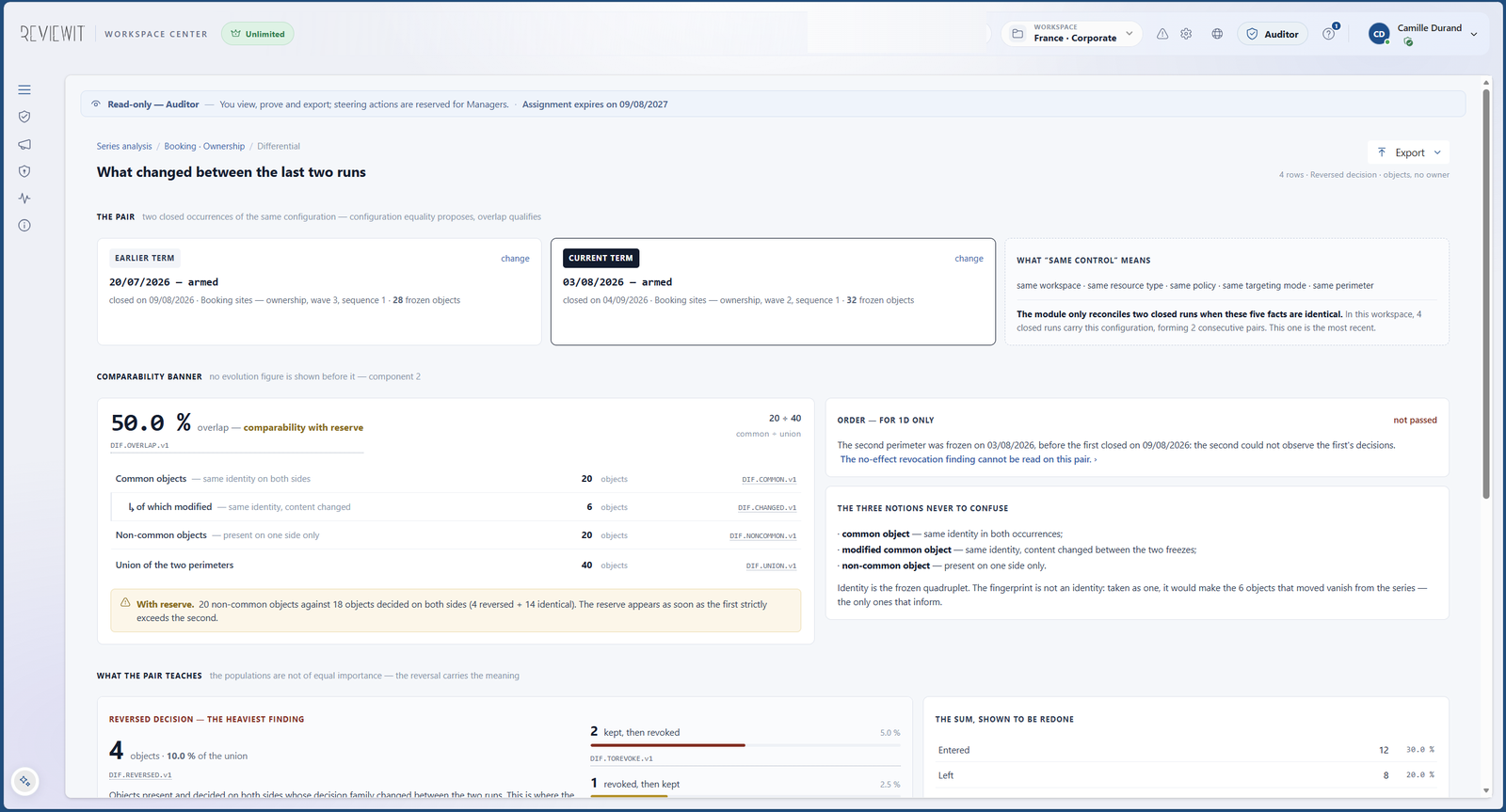
Four readings a dashboard does not give you.
What is comparable
Same workspace, same resource type, same policy, same targeting mode, same scope. Excluded occurrences come with their reason.
What changed
Objects in common, changed, entered, left. Kept, revoked, waiver, divergent: every change of family, in figures.
What came back
Objects revoked last time and presented again. The module names the fact and its two possible causes.
What the series teaches
Revocation effort, decision times, concentration on a single reviewer — from governed, versioned definitions.
Trends on validity, not just on decisions.
With continuous assurance, INSIGHTS also tracks what happens between two closures: how many attestations held, how many had to be decided again, and why.
Demonstration data.
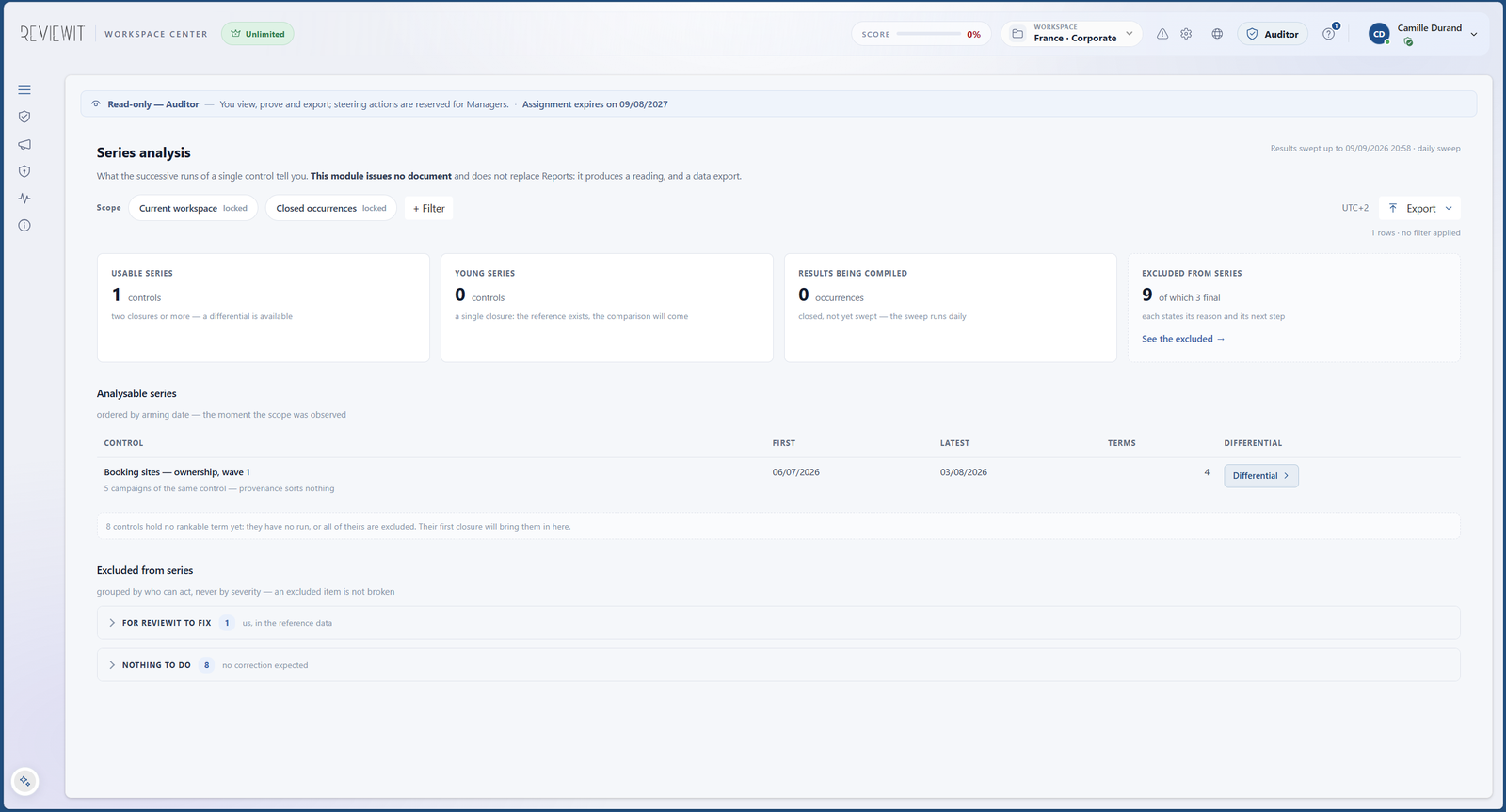
The questions a second campaign should answer.
What changed?
Between two occurrences of the same series: objects present in both, identical decisions, and every change of family. Kept to revoked, revoked to kept, revoked to waiver, co-owners now divergent. Three directions, not two.
What came back?
Objects revoked last time and presented again this time. Either the revocation was never applied, or the access was granted again. The module names the fact and both causes. It does not guess which.
Is the effort worth it?
Revocation effort per occurrence, decision times at median and 90th percentile, concentration on a single reviewer or on the top three. Whether the campaign teaches your reviewers something, in figures.
The finding that points outside the platform.
REVYCORE certifies decisions. It does not execute them. So an access revoked in the last campaign and presented again in this one is either a revocation that was never applied, or an access granted again. Both are facts about your organisation, and both deserve to be named.
The chain.
Revoked last time, presented again this time, then kept again. Three links, each with its figure.
Two causes, no verdict.
The module does not decide which cause applies. It gives you the list to find out.
An argument for the committee.
“We revoked 340 access rights and 120 are still active” is a diagnosis of your remediation, made by your certification tool.
What INSIGHTS refuses to do, on purpose.
No reviewer is ever measured.
Complacency is measured at the level of the review programme, never of the person. The contract makes it impossible to compile a reviewer’s identity into a metric.
No auditor access.
INSIGHTS carries a self-critique. It is yours. Auditors read the sealed evidence, not your analysis of it.
Neither an alert nor a signed document.
A series finding is never closed and has no action in the product, so it is not an alert. It is exported as data, never as a signed document.
No unratified figure.
A metric whose threshold is not yet calibrated on real data shows a dash and its reason. A new notion is amber and marked “to be decided”.
Certified yesterday. Provable today.
A demonstration in your context: your solutions, your scopes, your agents.